Tel: +86-18874804206 E-mail: sales@innovequipment.com


- All
- Product Name
- Product Keyword
- Product Model
- Product Summary
- Product Description
- Multi Field Search

- Home
- Products
- ABOUT US
- News
- Application
- FAQ
- Contact Us
Views: 117 Author: Site Editor Publish Time: 2026-01-01 Origin: Site

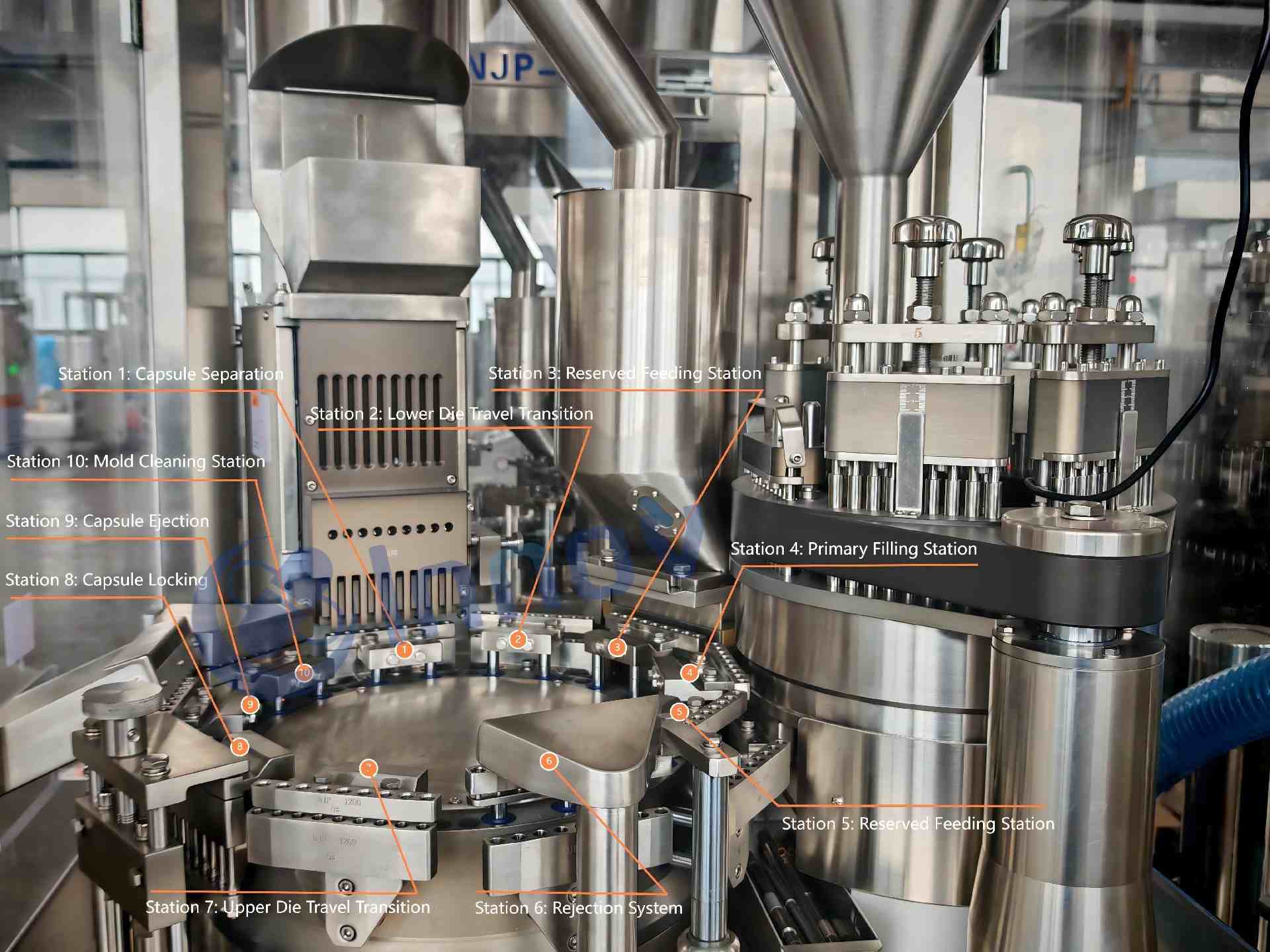
The NJP series represents an integrated electromechanical-pneumatic automation system. Driven by a main motor through a indexing box and cam-linkage mechanism, it coordinates multiple stations to achieve capsule separation, material filling, waste removal, capsule closing, product ejection, and mold cleaning. Key features include:
Compact structural design
Advanced automation level
High operational availability
Dosing accuracy ≤±3%
Material recovery rate ≥99.5%
Quick mold changeover (<15 min)
Low noise operation (<75 dB(A))
Dosing accuracy serves as the critical performance indicator. Our machine employs a plug-type dosing mechanism where filling volume is determined by the diameter (Φ2.5-Φ12mm) and thickness (3-15mm) of measuring disc holes, correlated with material bulk density (0.4-1.2 g/cm³). Notably, dosing precision is influenced by both machine parameters and environmental/material factors.
| Parameter | Specification | Special Cases |
| Temperature | 21±3°C | Reduce for high-sugar/fat content materials |
| Humidity | 40-60% RH | Reduce for hygroscopic materials |
Critical Control: Maintain environmental stability to prevent material adhesion to punches, which may cause weight variation exceeding ±5%.
Optimal Specifications:
Particle size: 80-100 mesh
Uniform granulation (CV <5%)
Homogeneous density (RSD <3%)
Moisture content: <3% w/w
Flowability: 25-35° angle of repose
Anti-static properties
Compactibility index: 0.8-1.2
Process Recommendation: Adjust formulation excipients (e.g., add 0.5-1% colloidal silica) to approach these parameters when pharmaceutically permissible.
Critical Inspection Points:
Measuring disc holes (Ra ≤0.4μm)
Filling rod tips (Ra ≤0.2μm)
Acceptance Criteria: No visible scratches, dents, or foreign particles under 10× magnification
Optimization: Electrolytic polishing can reduce material adhesion by 30-40%.
| Component | Standard Clearance | Adjustment Range |
| Copper ring ↔ Measuring disc | 0.08-0.12mm | ≤0.2mm (sticky materials) |
| Partition block ↔ Measuring disc | 0.05-0.10mm | Non-contact operation |
Technical Note: Maintain contact surface finish (Ra ≤0.8μm) to prevent powder leakage exceeding 0.5% of batch weight.
Verification Protocol:
Clean rod seats (ultrasonic cleaning recommended)
Spring force test:
Vertical droop deviation: <1mm
Swing amplitude variance: <15%
Replace springs with >10% force variation
Sensor Calibration: 5-8mm detection range with 0.1mm repeatability
Feeding Strategy:
Delay time: 1-3s (adjustable via HMI)
Frequency: 8-12 feeds/min
Material Flow Aids:
Install agitator discs (rotation speed: 15-30 rpm)
Optimize machine speed: 2,000-2,800 cph
| Column Type | Weight CV | Machine Load | Recommended Action |
| Solid Column | ≤2% | High (≥85% rated) | Optimize punch taper angle |
| Semi-column | 3-5% | Medium | Use smaller disc holes (ΔΦ-0.5mm) |
| Granular | ≥8% | Low | Activate anti-leakage kit |
Corrective Actions:
Environmental control:
Dehumidify to ≤35% RH for hygroscopic materials
Cool to 18-20°C for fatty compositions
Mechanical adjustments:
Cam phase optimization (±5°)
Implement scraping mechanism (0.05-0.1mm clearance)
Utilize dual-channel weighing system (accuracy: ±0.1mg) to:
Detect front/rear row variations (>±3% indicates alignment issues)
Identify left/right deviations (>±2% suggests uneven compression)
Finer disc holes offer better stability than coarser ones
Thinner discs (3-8mm) outperform thick discs (>10mm)
High bulk density materials (≥0.8g/cm³) show 40% lower CV
Maintain powder level ≥80% ring height
Surface flatness tolerance: ≤1mm/m²
Level fluctuation should be controlled within ±3mm
Conclusion: Capsule weight uniformity (typically RSD 1.5-4.5%) is collectively determined by equipment condition (40%), environmental control (30%), and material properties (30%). Comprehensive process validation (≥3 consecutive batches) is recommended for critical formulations.


