Tel: +86-18874804206 E-mail: sales@innovequipment.com


- All
- Product Name
- Product Keyword
- Product Model
- Product Summary
- Product Description
- Multi Field Search

- Home
- Products
- ABOUT US
- News
- Application
- FAQ
- Contact Us
Views: 21 Author: Site Editor Publish Time: 2026-03-19 Origin: Site
A colleague recently asked me a very representative question: “We’re about to run dry heat sterilization on our vials. Do we need to control microbial load on the vials before the dry heat process? And after washing, do we still need to control both endotoxin and microorganisms?”
My answer was direct: No.I followed up with a clarifying question: “First, you need to understand — is the endotoxin removal step the washing process or the sterilization step?”
Although this is a basic question, it reveals a common misconception in everyday pharmaceutical manufacturing: many people confuse “physical removal” with “thermal destruction” and mistakenly apply terminal sterilization logic to dry heat depyrogenation processes.
Today, we’ll clearly break down the fundamental science behind vial washing and dry heat depyrogenation (endotoxin removal) to help you avoid compliance pitfalls.
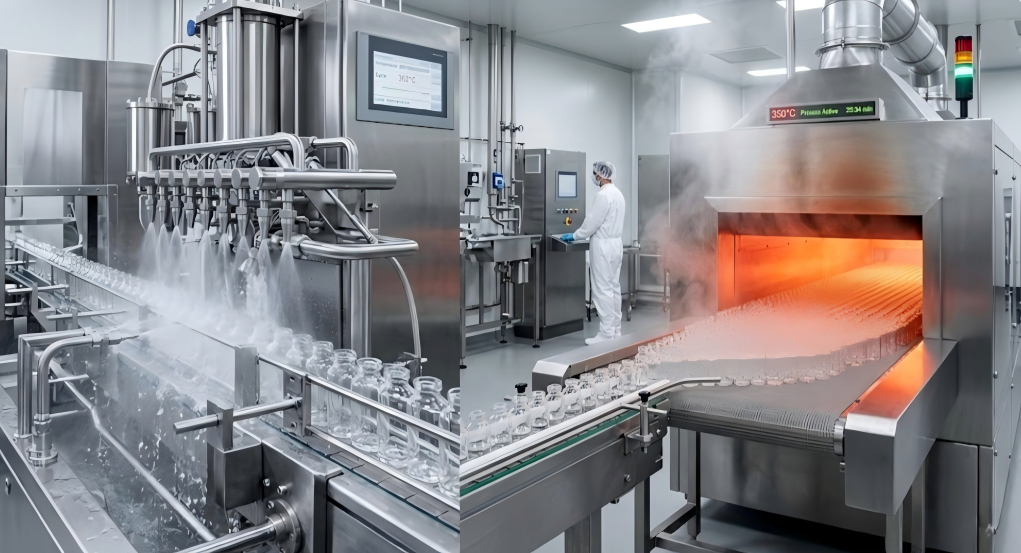
Once you understand the overkill principle, the answer becomes obvious.
Dry heat tunnel ovens are typically set at 300 °C or higher for depyrogenation. Bacterial endotoxin (lipopolysaccharide) is extremely heat-resistant, yet even the toughest bacterial spores have D-values of just a few minutes at 160 °C. At temperatures above 300 °C, microorganisms are essentially destroyed instantly.
The primary objective of the dry heat process is depyrogenation. As long as your cycle reliably meets the strict depyrogenation requirements, it automatically delivers complete overkill for any routine microbial load.
Therefore, routine microbial monitoring of washed glass vials before they enter the tunnel oven is neither necessary nor scientifically justified. Provided your wash water and controlled environment comply with GMP requirements, you already have sufficient control.
The original question confused the roles of vial washing and dry heat in endotoxin control. Both steps contribute, but their mechanisms are entirely different:
Vial washing = Physical removalWashing relies on high-pressure WFI jets, ultrasonics, and other mechanical forces to flush away visible particles, sub-visible particles, and some attached microorganisms and endotoxin. The validated purpose of the washer is to make the vial “clean” and control particulates. While washer validation may include an endotoxin challenge to demonstrate dilution/removal capability, washing is not the regulatory depyrogenation step.
Dry heat tunnel = Thermal inactivationThe tunnel oven is the true depyrogenation step. It uses extreme heat to thermally degrade and carbonize bacterial endotoxin — a genuine inactivation process. Validation must use high-concentration endotoxin indicators (typically ≥ 10,000 EU/vial) to prove at least a 3-log reduction in endotoxin.
Many new validation engineers wonder whether they should place both biological indicators (BIs) and endotoxin indicators (EIs) in the dry heat tunnel.
As explained above, the energy required for depyrogenation far exceeds that needed for sterilization. Industry guidelines (FDA, EMA, PDA, ISPE) agree: successful validation of a ≥3-log endotoxin reduction automatically demonstrates sterility assurance. Therefore, in performance qualification (PQ), an endotoxin challenge alone is sufficient to represent the sterilization effect.
Washing handles “cleaning.”
Dry heat handles “depyrogenation and sterilization.”
Washing is not a depyrogenation step, and a properly validated dry heat depyrogenation cycle will always deliver overkill sterilization.
Once you separate these two distinct processes, your validation strategy, routine monitoring plan, and daily controls become crystal clear — saving time, resources, and avoiding unnecessary deviations.
If you’re responsible for vial preparation, washer validation, or dry heat tunnel PQ, bookmark this guide. Understanding the science behind “wash” versus “heat” is one of the simplest ways to strengthen your contamination control strategy and stay GMP-compliant.


